|
|
|
|
|
|
|
of flow (m2), equation (12.4) can be written as: |
|
|
|
|
|
|
|
|
Writing r = krD and kaD2 where ka is a function of d/D (Table 12.1): |
|
|
|
|
|
|
|
|
Substituting equation (12.3) in equation (12.6): |
|
|
|
|
|
|
|
|
The minimum gradient, Imin, is given by rearranging equation (12.7) and writing i = Imin andt = tmin: |
|
|
|
|
|
|
|
|
Equation (12.6) can be rearranged, with i = Imin, as: |
|
|
|
|
|
|
|
|
12.3
Number of Households Served |
|
|
|
|
|
|
|
|
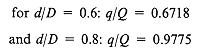
Examination of Table 12.1 shows that the proportional flow q/Q (where q is the flow in the sewer at any given depth of flow d and Q is the flow at d = D) is given as follows: |
|
|
|
|
|
|
|
|
So designing simplified sewers to flow now with a d/D of 0.6 allows for an increase in water consumption of [(0.9775-0.6718)/ 0.6718], i.e. 46 per cent, for example from 100 to 146 lcd, which seems a more than adequate allowance. |
|
|
|
|
|
|
|
|
Equations (12.8) and (12.9) can now be solved for d/D = 0.6 (i.e. from Table 12.1, ka = 0.4920 and kr = 0.2776), with tmin = 1 Pa, n = 0.013, r = 1000 kg/m3 and g = 9.81 m/s2, and expressing q in 1/s rather than m3/s: |
|
|
|
|
|